
The Kerala high court has delivered a landmark judgment, empowering Christian women in India to file for divorce from their current place of residence, thereby removing a significant procedural hurdle and ensuring equal access to justice.

The Supreme Court of India has dismissed a petition seeking to abolish execution by hanging, affirming its legality while strongly emphasising that the State must carry out capital punishment in a manner that minimises suffering and preserves human dignity, even for condemned prisoners.

IT Secretary S Krishnan advocates for India to pursue "strategic autonomy" in the AI ecosystem by building domestic capabilities and diversifying global supply chains. He emphasized avoiding overdependence on single sources while integrating into trusted global networks, and also highlighted the need to consider an AI law and regulatory framework.
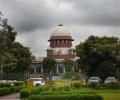
In a significant verdict, the Supreme Court on Friday said the mere absence of a train ticket on the body of a deceased passenger cannot be a ground to deny compensation to the victim's family in a railway-accident case.

FIFA's proposal to create a $20 billion subsidiary for the World Cup highlights the intricate balance of power in global football, where the governing body's authority is often challenged by the significant commercial strength of UEFA, particularly in Europe.

India's Code on Wages mandates strict payout deadlines, two-day full and final settlements, universal wage coverage and capped deductions to safeguard employees and enhance payroll transparency nationwide.

The US Supreme Court is poised to rule on the legality of state laws in West Virginia and Idaho that ban transgender student athletes from female sports teams. This contentious issue, deeply embedded in the nation's culture wars, challenges federal anti-discrimination laws and the Constitution's equal protection clause.
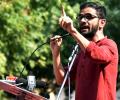
The Supreme Court granted interim bail to two Delhi riots accused, while addressing concerns about conflicting views on bail under the Unlawful Activities Prevention Act (UAPA). The court referred the question of law on whether prolonged incarceration can override UAPA restrictions to a larger bench.
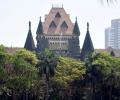
The Bombay High Court has referred to a larger bench the question of whether the state can deny furlough to prisoners convicted under special statutes like MCOCA and POCSO, citing potential violations of fundamental rights.

The pleas challenging SIR claimed that the Election Commission does not have powers under Article 326 of the Constitution, the Representation of the People Act, 1950 and the Rules made under it to carry out SIR in a larger form.
The Bombay High Court has questioned the denial of furlough to prisoners convicted under special Acts, citing a potential violation of fundamental rights. The issue has been referred to a larger bench due to conflicting previous judgments.

The Indian Parliament has passed a bill amending the Transgender Persons (Protection of Rights) Act 2019, focusing on biological discrimination and excluding social orientations from its scope. The bill aims to provide legal recognition and protection to transgender individuals facing discrimination due to biological issues, while also introducing graded punishments for harm inflicted on them.
The Supreme Court expressed deep regret that the actual perpetrator of the Nithari killings was not established despite a prolonged investigation, while acquitting Surendra Koli in the last Nithari murder case.
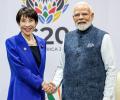
If they act now, they can reshape the strategic map of Asia without firing a shot. If they wait, the next opportunity will come only after a serious Taiwan Strait incident -- by which time the price will be far higher, and the room for boldness far smaller -- the opportunity may well be lost by then. The question is no longer whether this can or should be done, points out Varun Arya.

The high court erred in holding that the law was violative of the principle of secularism, said a bench comprising Chief Justice of India D Y Chandrachud and Justices J B Pardiwala and Manoj Misra.

X calls the home ministry's Sahyog portal a 'censorship portal', stating it usurps judicial functions.

The plea claimed the blocking was effected by the intermediary pursuant to an undisclosed direction allegedly issued by the Centre citing vague grounds of "national security" and "public order".
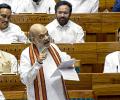
'This type of comprehensive legislation has never been introduced before in Parliament's history.' 'A bill that simultaneously affects ministers, chief ministers, and the prime minister represents completely uncharted Constitutional territory.' 'Throughout our nation's legislative history, the established policy has consistently held that public office holders should face punishment only after receiving conviction from a competent court of law. Without this safeguard, we risk systematic destabilisation, and our federal structure would face complete collapse.' 'Any central government could potentially deploy this legislation against state governments they oppose politically. This represents the most frightening prospect and dangerous possibility that these bills create.'
The Supreme Court of India has sought responses from the Centre and others on a petition challenging the blocking of the YouTube channel '4PM'. The petitioner, Sanjay Sharma, the Editor of the channel, alleges that the blocking order, issued by an intermediary based on an undisclosed direction from the Centre, violates his right to free speech and the public's right to information. The plea argues that the blocking was based on vague grounds of 'national security' and 'public order' without any opportunity to be heard. The court has issued notices to the Centre and others seeking their responses on the petition.
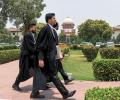
Underscoring the 'presumption of constitutionality in favour of law', the Supreme Court on Tuesday said petitioners challenging the waqf law needed a 'strong and glaring' case for interim relief.
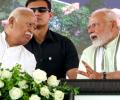
BJP and RSS leaders are once again pushing to remove the words 'secular' and 'socialist' from the Constitution's Preamble, showing a deeper effort to change India's identity from a diverse, multi-religious republic to a Hindu-first nation, even though they don't have the numbers in Parliament to officially change the Constitution, observes N Sathiya Moorthy.
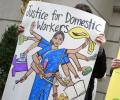
The Supreme Court of India directed the government to establish a legal framework to protect domestic workers and address their exploitation.
The bench noted that this case illustrates how administrative apathy can defeat the benefit of provisions of the Rights of Persons with Disabilities Act, 2016, enacted to support persons with disabilities.
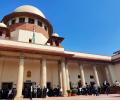
The bench said the ED officers acting under the Section 19(1) of the Prevention of Money Laundering Act (PMLA) cannot ignore or not consider the material which exonerates the arrestee.

An institution of national importance must reflect the "national structure", the Centre told the Supreme Court on Tuesday while pointing out that around 70 to 80 per cent students studying at Aligarh Muslim University (AMU) are Muslims even without reservation.

Lord's, the 'home of cricket', will host its first-ever Women's Test between India and England in 2026, the ECB announced on Thursday.

The court said the decision shall be communicated by the Union ministry of health and family welfare for considering whether any law, enactment, or guidelines are required to address issues related to posthumous reproduction or post-mortal reproduction.

Prime Minister Narendra Modi led-NDA government in its third term must tackle the problem of unemployment in the country, especially in the unorganised sector and in small and medium enterprises, former NITI Aayog Vice Chairman Rajiv Kumar said on Monday. Kumar also emphasised that the government now must finalise the four labour codes as it has been delayed beyond expectations. "We must recognise that post-COVID economic recovery has been a K-shaped recovery.
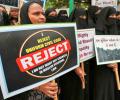
In an editorial in its mouthpiece Saamana, the Uddhav Thackeray-led party said Prime Minister Narendra Modi should first respect uniform law by disqualifying 40 MLAs including Maharashtra Chief Minister Eknath Shinde, whose Urban Development department has taken action against 18 ex-corporators from the Bhiwandi Nizampur City Municipal Corporation (BNCMC).
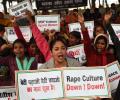
Under the exception given in Section 375 of the IPC, sexual intercourse or sexual acts by a man with his wife, the wife not being minor, is not rape.

The Supreme Court on Tuesday referred to a Constitution bench of at least five judges a batch of pleas challenging the constitutional validity of the colonial-era provision of sedition under the Indian Penal Code (IPC).

Observing that the trial court conducted proceedings with a "predetermined notion of conviction", a division bench of Justices AS Supehia and Vimal K Vyas quashed the CBI court's order sentencing Solanki and the six others to life imprisonment.

The Supreme Court on Friday asked what was the harm if a person provided the details of caste or sub-caste during the Bihar caste survey when an individual's data was not going to be published by the state.
The top court said there are serious lapses in the enforcement of the 2013 Prevention of Sexual Harassment Act.

The bench in its order held that the scope of the Scheduled Castes and the Scheduled Tribes (Prevention of Atrocities Act) cannot be limited to the state where a person is declared as a member of the Scheduled Caste or Scheduled Tribe community.

The Delhi high court on Monday sent to the Supreme Court a batch of petitions seeking to recognise same-sex marriages under various laws.

Hours after Desai said that the draft is ready to be submitted to the state government, Chief Minister Pushkar Singh Dhami said the Uniform Civil Code will soon be implemented in Uttarakhand.

Addressing a public meeting after unveiling a 125 ft-tall statue of B R Ambedkar here, KCR said the BRS party was getting a tremendous response from Maharashtra and was expecting a similar reaction from West Bengal, Bihar, and Uttar Pradesh.
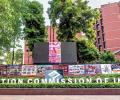
Justice Rastogi asks Mehta if he thinks that in the absence of law, whatever appointments are being made in a process are appropriate.
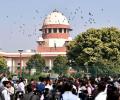
The appeal against the high court order came up for hearing before a bench of justices A S Bopanna and P S Narasimha, which stayed it.
